
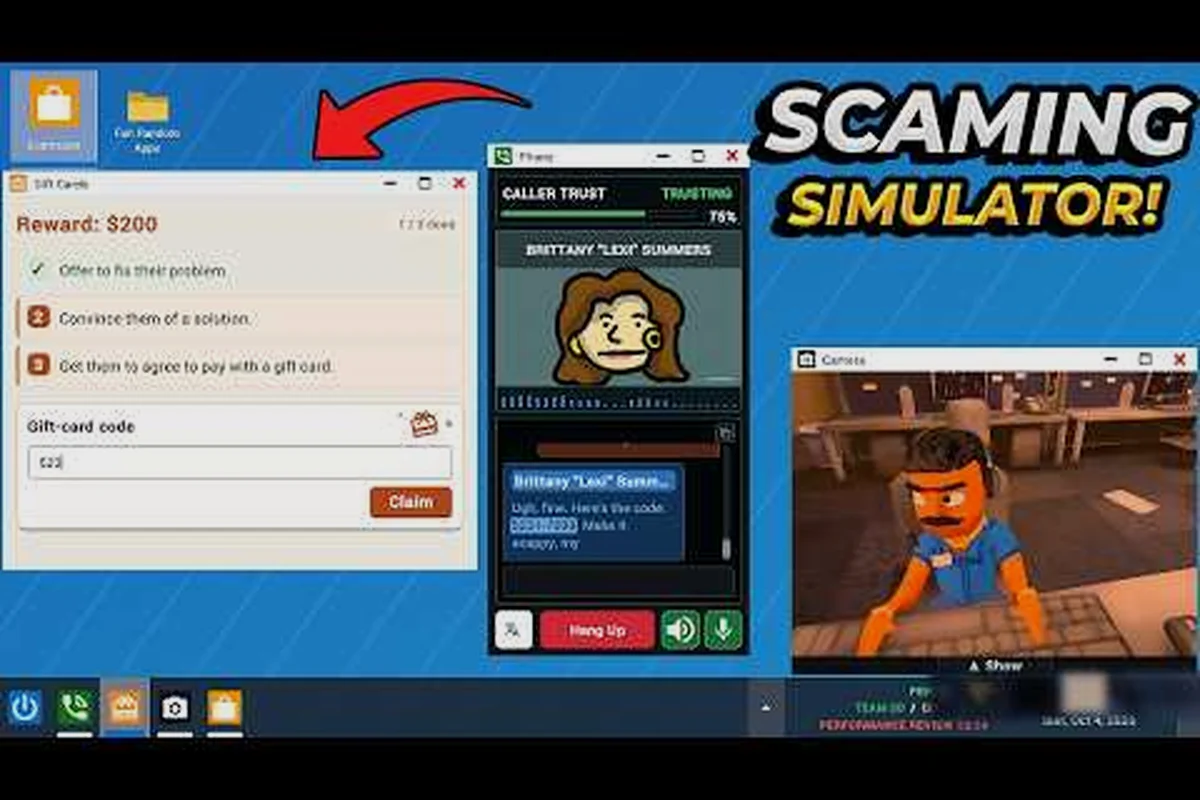
Progress in Scam With Your Friends is not a slow grind — it is a series of runs, and every run either pushes your career forward or burns a day you cannot get back. Understanding run-based progression early is the difference between a clerk who claws toward the corner office and one who gets fired by week two.
How Run-Based Progression Actually Works
Every shift in Scam With Your Friends is a self-contained run with its own time limit, its own callers, and its own payout. When the shift ends, the money you banked converts into permanent unlocks that carry into the next run. That loop — run, bank, unlock, repeat — is the entire spine of the game, and once you internalize it, the upgrade screen stops feeling random.
The key insight most new players miss is that in-run cash and permanent progression are two different currencies. Money you spend mid-shift on a risky scheme is money that never reaches your unlock pool. In practice, players who bank aggressively in their first few runs unlock core tools roughly twice as fast as players who gamble everything on one big score.
Here is how a typical run breaks down: the Opening calls phase is your safest window, where low-value targets like a confused grandparent or a wrong-number pickup build caller trust without spiking attention. The Mid-shift window is where runs are decided — payouts jump sharply, but so does the attention you draw, and this is the stretch where most banked totals are either secured or thrown away on one greedy scheme. The Final stretch compresses everything under time pressure, forcing panic decisions that determine your banked total, and the Post-shift converts that cash into permanent unlocks. Reading which phase you are in tells you whether to push or protect your stack.
| Run Phase | What Happens | Progression Impact |
|---|---|---|
| Opening calls | Low-value, low-risk targets | Builds caller trust safely |
| Mid-shift window | Higher payouts, higher attention | Where most runs are won or lost |
| Final stretch | Time pressure, panic decisions | Determines banked total |
| Post-shift | Cash converts to unlocks | Permanent power increase |
The shift timer is the single most important constraint in the game. It does not pause, it does not forgive, and it does not care that you were one call away from a clean sweep. Learning to read the clock and cut your losses is a skill that separates intermediate players from veterans.
If you are struggling to survive the rough runs where nothing lands, the comeback and efficiency strategies cover how to salvage a bad day instead of writing it off. The core principle is triage: when your banked total is already thin, the Mid-shift window's high-payout targets are a trap, not an opportunity, because a single blown scheme burns both the caller trust you built during Opening calls and the clock you need for the Final stretch. Veterans treat a bad run as a floor-protection exercise — bank one clean mid-size payout, then coast the remaining time on low-attention wrong-number pickups rather than chasing a comeback caller that draws too much attention to recover from. That salvaged cash still converts at Post-shift into unlock progress, which means even a "failed" shift advances your permanent pool instead of resetting it.
Why Banking Beats Gambling
A run where you bank a modest, reliable total is worth more than a run where you swing for a huge payout and lose it all to a failed scheme. The math is simple: unlocks compound, but failed runs do not. In practice, the players who climb fastest treat each run as a deposit, not a lottery ticket.
Reading the Shift Timer
Treat the last third of the timer as your cash-out window. Stop opening new high-risk calls and start closing what you already have. Veterans call this "locking the bag," and it is the habit that keeps a run from turning into a wipe.
Unlock Priorities: What to Buy First
The unlock tree is where run-based progression gets interesting, because you cannot buy everything and the order you buy in shapes your entire career arc. A scam with your friends upgrade guide only helps if it tells you what to skip, not just what to grab.
Broadly, unlocks fall into three buckets: tools that raise your payout ceiling, tools that lower your risk per call, and tools that extend your run length. New players almost always over-invest in payout tools and under-invest in risk reduction, which is why their runs are volatile and their banked totals are inconsistent.
| Unlock Category | Example Effect | Priority for New Players |
|---|---|---|
| Payout ceiling | Higher max per successful call | Medium |
| Risk reduction | Lower chance of a blown call | High |
| Run extension | More time before the shift ends | High |
| Convenience | Faster call handling | Low |
The risk reduction line is the quiet MVP of early progression. A tool that shaves a few percent off your failure chance does not look exciting on the unlock screen, but across twenty runs it is the difference between a stable climb and a coin flip every night.
The Trap of Chasing Big Numbers
New players see a big payout unlock and assume it is the obvious pick. It usually is not. A high-ceiling tool that you cannot safely use is worse than a modest tool you can fire off every single run. Consistency compounds; spikes do not.
When to Branch Out
Once your risk tools are solid and your banked totals are stable, that is the moment to start investing in payout ceiling. Branching too early is the most common progression mistake in the game, and it is the reason so many players plateau around the same level.
Leveling Fast Without Burning Runs
Leveling fast in Scam With Your Friends is less about playing more and more about playing efficiently. Every run has a fixed time cost, so the players who level fastest are the ones who extract maximum progression value per shift rather than grinding extra hours.
The core principle: never end a run with unbanked potential. If you have calls you could have closed but did not, you left progression on the table. Efficient players plan their run backward from the timer, deciding early which calls they will close and which they will skip.
| Efficiency Habit | Effect on Leveling Speed |
|---|---|
| Banking every run | Steady, compounding unlocks |
| Closing calls before time pressure | Fewer blown calls |
| Skipping low-value early calls | More time for high-value ones |
| Reviewing the unlock tree between runs | No wasted purchases |
The unlock tree review habit is underrated. Spending thirty seconds between runs deciding your next purchase prevents the classic mistake of buying something you did not need because you were in a hurry. Reported by players, this single habit is one of the most common pieces of advice in progression threads.
Pacing Your Sessions
Long sessions do not automatically mean fast leveling. Fatigue leads to sloppy calls, and sloppy calls lead to failed runs, which are pure progression loss. Short, focused sessions with a clear goal for each run outperform marathon grinds almost every time.
Tracking Your Own Progress
Keep a rough mental note of your average banked total per run. If it is climbing, your unlocks are working. If it is flat, you are probably over-investing in payout and under-investing in risk. That single number tells you more about your progression health than your level does.
Difficulty, Day Cycle, and Long-Term Scaling
Progression does not happen in a vacuum — the game scales around you. The day cycle advances, difficulty ramps, and the calls you handled easily in week one become genuinely dangerous later. Understanding this curve is essential if you want to keep leveling instead of hitting a wall.
As the day cycle progresses, the risk per call rises and the margin for error shrinks. This is why risk-reduction unlocks stay valuable far longer than payout unlocks — they scale with the difficulty instead of being outpaced by it. Players who understand the day cycle and difficulty scaling plan their unlocks around surviving the late game, not just the early runs.
| Game Stage | Difficulty Feel | Best Unlock Focus |
|---|---|---|
| Early days | Forgiving, low attention | Risk reduction + run extension |
| Mid cycle | Balanced, real stakes | Payout ceiling + risk |
| Late cycle | Punishing, tight margins | Survival and consistency tools |
The late-cycle margin is where most careers stall. If you spent your early unlocks on flashy payout tools, you arrive at the hard days with no safety net. If you invested in consistency, you arrive with a toolkit that still works when everything is on fire.
Planning Around the Difficulty Curve
Treat every unlock purchase as an investment against the run's hardest checkpoint, not a comfort buy for the floor you're standing on right now. In scam with your friends, run-based progression means an upgrade that trivializes your first few calls often becomes dead weight once quotas rise and callers get harder to convince. That's why the best upgrades in a scam with your friends upgrade guide skew toward permanent utility — faster lookups, quieter cleanup, more resilient desk gear — rather than a one-shift gimmick. Ask yourself: will this item still matter when the group is split, the shift clock is short, and someone is juggling a live caller? If the answer is no, skip it and bank the cash toward the next upgrade. This single reframe is the difference between leveling up fast and stalling out on the same floor repeatedly.
When to Slow Down
If your runs start failing more often, that is a signal to stop pushing difficulty and consolidate. Banking reliable totals on easier days rebuilds the cushion you need to survive the hard ones. Progression is not always forward — sometimes it is holding ground.
Schemes, Trust, and the Unlock Web
Your unlock options are not just tools — they are schemes, and schemes are gated behind caller trust. The more trust you build, the more schemes open up, and the more schemes you have, the higher your payout ceiling climbs. This is the web that ties run-based progression together.
Building caller trust is a slow, deliberate process. It rewards patience and punishes recklessness, which is why players who rush the early calls often find themselves stuck with a thin scheme list. The caller trust and scheme unlock system explains how trust gates your options and why some schemes stay locked far longer than expected.
| How much trust | Typical Scheme Access | Progression Value |
|---|---|---|
| Low | Basic, safe calls | Foundation building |
| Medium | Higher-payout schemes | Real income growth |
| High | Premium, high-risk schemes | Late-game ceiling |
The premium schemes at high trust are where the biggest payouts live, but they are also where the biggest failures happen. Unlocking them is not the goal — using them safely is. A player with high trust and disciplined call selection will out-earn a reckless player with the same unlocks every single time.
Trust as a Progression Currency
Trust functions as a second currency in Scam With Your Friends, but unlike cash it can't be farmed back with a quick run — it regenerates only through clean extractions and honest splits. That asymmetry is the whole point: one blown call, whether a failed escape or a cut you didn't agree on, can cost you access to the highest-value lobbies and the best upgrades your crew has already unlocked. Track your trust balance the same way you track your cut, because depleted trust locks you out of run-based progression faster than any lost payout.
Balancing Schemes and Tools
Do not neglect your tool unlocks while chasing schemes. The two systems feed each other — schemes give you the payout, tools give you the safety to collect it. A career built on only one of them will stall. Concretely: sinking every early level into higher-value scam targets raises your payout ceiling, but without the matching tool unlocks — the drill for breaching harder vaults, the scanner for reading guard patrol routes before you commit — you'll hit a ceiling where the loot is visible but unreachable. Flip the imbalance and the opposite happens: a fully upgraded toolkit lets you survive a run, yet a weak scheme caps what that survival is actually worth. Treat your level-ups as a split budget rather than a single track, and rebalance whenever one side starts gating the other.
Frequently Asked Questions
How do I progress fastest in Scam With Your Friends?
Bank a reliable total every run instead of gambling on one big score, and prioritize risk-reduction unlocks before payout unlocks. Consistency compounds across runs, while failed runs give you nothing. Players who bank aggressively unlock core tools noticeably faster than those who chase spikes.
What are the best upgrades to buy first?
Start with risk reduction and run extension tools, since they lower your failure rate and give you more time per shift. Payout ceiling unlocks are tempting but should wait until your runs are stable. This order keeps your banked totals climbing instead of swinging wildly.
How do I level up fast without grinding extra hours?
Plan each run backward from the shift timer, close your calls before the final stretch, and skip low-value early calls that eat time. Reviewing the unlock tree between runs also prevents wasted purchases. Efficiency per run matters far more than total hours played.
Why do my runs keep failing as the day cycle advances?
Difficulty scales with the day cycle, so the calls that were safe early become genuinely dangerous later. If you invested only in payout tools, you have no safety net for the hard days. Rebalancing toward risk reduction and consistency tools fixes most late-cycle stalls.
Do schemes or tools matter more for progression?
They feed each other, so neither wins alone. Schemes raise your payout ceiling, while tools give you the safety to actually collect those payouts. A career built on only one of the two systems will plateau, which is why balanced spending across both is the reliable path forward.
Progression in Scam With Your Friends rewards the player who treats every run as a deposit rather than a gamble. Bank consistently, buy risk reduction before payout, respect the shift timer, and let your unlocks compound across the day cycle. Do that, and the corner office stops feeling like a distant dream and starts feeling like the next logical step.